
Sole Bespoke Consulting — Industry Insight
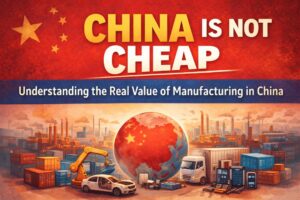
Made in China is not cheap.
It is engineered.
The biggest misconception companies carry into China is also the one most likely to cost them. Here is what the data — and decades of production — actually shows.
The Foundation
Why China became the world’s manufacturing hub
China’s dominance is the result of decades of deliberate system-building — not a lucky abundance of cheap labour. The country holds the position it holds because it built the infrastructure to hold it.
Industrial clusters consolidate raw materials, components, tooling, assembly, packaging, and logistics into the same regions. Scale advantages allow millions of units to be produced with consistency and a low error margin. Speed-to-market is unmatched by most alternatives, and manufacturing expertise has been developed across generations of production.
People used to doubt Chinese products — and often for good reason based on earlier experiences. After a decade of massive industrial investment, however, China has comprehensively upgraded its factories and is now a respected world leader in precision manufacturing.
China is not the global manufacturing hub because it is cheap. It holds that position because it is efficient, scalable, and structurally advanced.
Industrial Clusters
Raw materials, components, tooling, assembly, packaging, and logistics — all in the same region, streamlining production at every level.
Unmatched Scale
Millions of consistent units with low error margins, driven by manufacturing systems refined over generations of output.
Speed to Market
From prototype to production run, China’s throughput speed is rarely matched by alternative sourcing destinations.
Generational Expertise
Manufacturing knowledge developed and passed down over decades, embedded in the culture of production itself.
The Core Misconception
Cheap is a specification. Not a default.
China can produce cheap goods. It can also produce world-class goods. The outcome depends entirely on what you specify, not on where you source.
Low-quality results typically come from vague or incomplete specifications combined with over-aggressive cost pressure — the unrealistic expectation of a premium product at a low-grade price. Poor supplier selection compounds the problem: a factory’s claimed portfolio or years of experience does not guarantee it has the specific capacity or standards required for your project.
Without independent factory audits or rigorous post-production quality control inspections, businesses gamble on a supplier’s integrity — and often lose in ways that could have been avoided with professional oversight.
Where the “cheap China” myth is manufactured
The narrative is frequently reinforced by bulk dealers who intentionally source low-grade or refurbished goods to undercut competitors in their home markets. End users build their businesses on this misperception and come to China expecting the same — only to face a sharp reality when their budget cannot purchase their expected quality and quantity.
Driven by the disconnect between budget and expectation, many inexperienced buyers skip essential verification steps in a desperate search for the lowest bidder, inadvertently repeating the cycle they were hoping to escape.
Factory Reality
Quality in China is not assumed. It is engineered.
Some of the same factories that produce low-cost items also produce premium products for different clients under tighter controls. Most factories do not want to miss a large order and will say “can do” — then find a way to deliver to your specifications, whether cheap or expensive. However, there is a limit to how low they can go.
There are factories where, due to a long period of working with certain premium brands, they no longer accept orders below a certain standard. They have built their manufacturing capacity, trained their teams, and oriented every part of their operation around producing high-standard, precision goods for a specific demographic of businesses.
Working with them, you can see from their work ethics and their factory space why they cannot accept anything below a certain standard — it is detrimental to their equipment and an economic loss for them.
We constantly work with factories that produce goods for very famous brands. You can see from their work ethics exactly why they can’t accept anything below a certain standard.
Electronics
China produces everything from disposable accessories to precision components for global brands — often in the same industrial regions.
Automotive & EVs
Chinese manufacturers now compete globally on performance, safety, and innovation — not just on price.
Telecommunications
High-tech pivots in telecom and aerospace show China’s ambitions extend well beyond low-cost assembly.
Aerospace
A growing presence in aerospace manufacturing reflects decades of investment in precision engineering capability.
As labour costs in China have risen, the country has pivoted toward high-tech and high-precision manufacturing. This means that “cheap” labour is actually harder to find than it was 20 years ago — if a price seems unbelievably cheap today, it almost certainly indicates a compromise in material quality or ethical standards.
The Strategic Error
China punishes weak processes. It rewards structured ones.
The biggest mistake companies make is treating China as a shortcut. China is not a forgiving environment for vague briefs, absent oversight, or poor communication. But it strongly rewards businesses that come prepared.
China is not forgiving of
- Weak or undefined processes
- Lack of on-ground oversight
- Poor or ambiguous communication
- Chasing price over specification
China strongly rewards
- Clear, detailed specifications
- Ongoing quality control processes
- Structured, professional sourcing
- Local expertise and partnership
What Businesses Should Do Instead
Treat China as a strategic manufacturing partner
Stop leading with price alone
Define what you need to achieve — then find the right price for that outcome. Price-first sourcing is the fastest route to the very quality problems you are trying to avoid.
Invest in supplier vetting
A factory’s claimed portfolio or years in business does not guarantee the specific capacity or standards your project requires. Independent audits are not optional — they are the baseline.
Define quality standards clearly
Vague specifications produce vague results. Every dimension, material grade, tolerance, and finish should be documented before production begins.
Implement on-ground controls
Quality control inspections during and after production catch problems before they become expensive. Remote oversight is not a substitute for physical presence.
References & Further Reading
- Financial Times — China’s manufacturing ecosystem and industrial policy
- Reuters — China’s EV and advanced manufacturing competitiveness
- China-Britain Business Council — Quality control in Chinese manufacturing
- Alibaba Group — Scale and efficiency in Chinese production
Work With Sole Bespoke Consulting
Operate in China with clarity and control
Whether you’re entering China for the first time or fixing an existing operation, we provide bespoke, on-the-ground support.
Sourcing & Procurement Setup
Supplier Audits & Quality Control
Outbound Logistics Coordination